MATERIALS
- Music player and prepared music
- computer/White Board/computer or IPAD
- origami Paper
SHORT DESCRIPTION/TOPIC
Students will enjoy many wonderful sea inspired yoga poses and learn some awe inspiring and fun facts about our oceans and some of their wonderful inhabitants.
DISCUSSION POINTS
- Around 70% of the Earth’s surface is covered by oceans.
- The largest ocean being the Pacific Ocean, covers around 30% of the Earth’s surface.
- About 70% of the oxygen we breathe is produced by the oceans
- The world’s oceans are home to incredible creatures that are masters of disguise! Take a look for yourself…
Note: If you have time, play Underwater Astonishments, a 5 minute Ted Talk with David Gallo
Note: If you have time, share a bit about pollution and our oceans.
Save our oceans and all that live in them! The oceans are so vast and deep that until fairly recently, it was widely assumed that no matter how much trash and chemicals humans dumped into them, the effects would be negligible. But we now know that’s not true. Pollution is the introduction of harmful contaminants that are outside the norm for an ecosystem. Many of these pollutants collect at the ocean’s depths, where they are consumed by marine life and introduced into the food chain — even being eaten by us! Many ocean pollutants are released into the environment nitrogen-rich fertilizers applied by farmers end up in local streams, rivers, ending up being pushed into the ocean, These create algae that rob the water of oxygen, leaving areas where little or no marine life can exist. Scientists have counted some 400 such dead zones around the world. Solid waste like bags, foam, and other items dumped into the oceans from land or by ships at sea are frequently consumed, with often fatal effects, by marine mammals, fish, and birds that mistake it for food. Discarded fishing nets drift for years, ensnaring fish and mammals.
CONNECTING CIRCLE
Fountain of Oms – Let’s tune into our own natural flow by chanting. Musical Musings, Quiet Quest
POSES AS PATHEWAYS/INTEGRATE THE ELEMENTS
Note: Play any of the following softly in the background while teaching this lesson. Musical Musings
- Octopus Garden by The Beatles
- Ultimate Ocean Waves Collection by Natural White Noise
- Pure Ocean Sounds by Sounds of the Ocean
All available on I Tunes
Root and Rise– To help us connect with the Earth
Reach for the Sun – To open a d warm ourselves up before we take our plunge into the ocean.
Sunrise/Sunset – Stretch the intercostal muscles of the rib cage, increasing lung capacity. The sun’s surface temperature is around 9941 degrees Fahrenheit, so pack plenty of sunscreen if you plan on visiting! Awesome Anatomy, Ecological Echoes
Roll-Ups – Over 100 joints allow for the spine’s extreme flexibility and range of movement. Awesome Anatomy
Swizzle Stick – Brain Balance
Waves – Today we are going on a sea adventure. Begin to ebb and flow like the waves, and co-ordinate your breath with the movement to get into the flow. Ocean waves are caused by wind moving across the surface of the water. The friction between the air molecules and the water molecules causes energy to be transferred from the wind to the water. This causes waves to form. Ecological Echoes
Row Your Boat – Uh-oh your boat has over turned and you’ve all rolled out into the waves!
Log Rolls – …..you got your groove back & now you are happily
Swimming (arms swimming motion) – Go from boat to log roll a few times, working together and coordinating the movements. We All Win
What creatures are we going to meet on our Sea Adventure?
Seagul – Rock from side to side as you bob on the ocean. Seagulls can drink fresh & salt water. Most animals are unable to do this, but seagulls have a special pair of glands right above their eyes which is specifically designed to flush the salt from their systems. Ecological Echoes
Spouting Dolphin – Dolphins use a blowhole on top of their heads to breathe. Compared to other animals, dolphins are believed to be very intelligent. Dolphins are carni-vores (meat eaters). The Killer Whale (also known as Orca) is actually a type of dol-phin. Ecological Echoes
Crab Eyes (adapted Eyes Around the Clock) – Imagine a clock hanging in front of your eyes. Repeat each direction 6 times, move your eyes to each position around the clock Did you know a crab has 5 eyes! Crabs have eyes on the stalks, just like snails. They can distinguish colors, but their eyes see a lot less details than human eyes. Brain Balance, Ecological Echoes
Talking Turtle – The turtle is another creature that lives in the water and on land. Turtles are cold blooded reptiles. All sea turtles drink only seawater all of their lives. They have special glands behind each eye, called “salt glands” that they use to get rid of all the salt from the seawater. Ecological Echoes
Bubble Fish – Make fish lips and blow bubbles exercising the mandible. Isn’t it magical that we can chew and speak because of this amazing joint. Fish breathe by taking water through their mouths and pushing it out through their gills. Awesome Anatomy, Ecological Echoes
Jabberwocky Jellyfish or Squid – Squish around like a squid. Make up some Jellyfish alliterations. Jumping jellyfish juggle jars of juice as they jubilantly journey. Laughing Language
Seal – Seals can sleep under water? They can hold their breath for up to 25 minutes and eat the equivalent of a 50pound hamburgers each day! Ecological Echoes
Om a LIttle Teapot – Do the pose while singing the below song to the tune of the Teapot Song: I’m a humpback whale, I’m very strong. I leap about And sing a song. I like to eat my fill In the Northern Sea. But in the winter, South I flee. I am a beluga, I’m all white. From head to tail I’m quite a sight. You can hear me singing Way up north, Playing and swimming Back and forth. I’m a mighty orca Black and white. In the sea I’m a beautiful sight. I’m not very big, But I am sleek. I hunt for my food Cause I have teeth. Ecological Echoes
Shake Like Seaweed (Shake Like Jelly) – There are thousands of varieties of seaweed. Seaweed is typically classified as marine algae rather than plants because they are larger & multi celled. Seaweed is normally green, brown or red. Ecological Echoes
READING COMES ALIVE WITH YOGA
Depending on the group, read one of the below:
- Affirmation Weaver – A Believe in Yourself Story designed to help children boost self-esteem while decreasing stress and anxiety
- Commotion in the Ocean – Dive into the ocean for a noisy rhyming romp packed with favorite sea creatures brought to life with fun, vibrant artwork
- The Snail & the Whale – One tiny snail longs to see the world and hitches a lift on the tail of a whale. Together they go on an amazing journey, past icebergs and volcanoes, sharks and penguins, and the little snail feels so small in the vastness of the world. But when disaster strikes and the whale is beached in a bay, it’s the tiny snail who saves the day.
VISUAL VIGNETTES
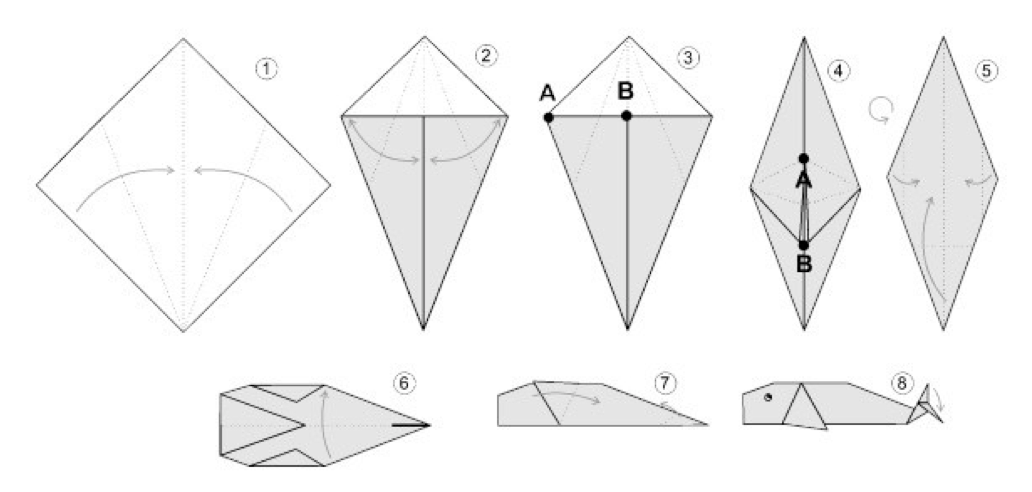
Origami Whales – Fold paper in half diagonally. Crease. Open up. Fold edges to center. Crease. Fold side points to center. Crease and open up. With your index finger, press point “A” to center, easing point “B” downward as shown in diagram above. Crease. Repeat for other side. Turn over. Fold bottom point up and both sides in. See diagram. Rotate 90°. Snip with scissors on bold line. Fold in half, crease Fold fin back and downward. Repeat for other side fold tail upward, separate and fold top piece downward. Glue on wiggle eyes
QUIET QUESTS
Sea Sponges – Take a little rest on the ocean floor. Begin in Child’s Pose. Imagine your body becoming very soft and light, just like a sea sponge. Gently rock your body back and forth with the sounds of the gentle waves. Feel the water moving though you as you sway back and forth. Use your hands and body to imitate the feeling of being gently rocked by the waters’ movement. Enjoy the liquidly flow. Rest. Bring yourselves back up slowly, curling yourself up out of your sponge ball into a sitting positions.
CLOSING CIRCLE
I hope you all had fun today on our Ocean Adventure. Think about how to conserve our oceans and the our sea life Visit the Aquarium, take a sea side walk, and see what you can find along the way. Collect all the rubbish you see and throw it away responsibly. I also encourage all of you to go on to the National Geographic for Kids Website….you will LOVE IT!