
Slow Sloth

Cartoon Sloth

MATERIALS

  • Slowly, Slowly, Slowly, Said the Sloth by Eric Carle
  • Music player and prepared music
  • Stuffed animals
  • Ropes or laces for walking
  • Cards for matching game,
  • Coloring pages

SHORT DESCRIPTION/TOPIC

The lesson is about mindfulness in the way we do things.

DISCUSSION POINTS

What would it be like to move slowly? Can you think of some animals that like to move
slowly?

CONNECTING CIRCLE

“Slowly, Slowly” Mindful Activity:

Let’s see what it’s like to move very slowly.

Raise an arm very slowly. Raise one leg very slowly. Notice the feeling in your whole body, slowly lower the leg Reach down and touch the floor in slow motion. Stay there for a few moments and notice the sensation in your body. Move your head from side to side. Do you feel sensations in other parts of the body? Now, try with eyes closed. How do you feel as you move slowly around?

POSES AS PATHWAYS/INTEGRATE THE ELEMENTS

D is for Dinosaur – Did you know Dinosaurs were really big and heavy animals and it wasn’t
easy for them to lift their heavy limbs and move? Let’s try to be mindful and feel like
dinosaurs as we slowly raise our arms and legs. Ecological Echoes

S is for SnakeAs you get into the pose, let’s practice saying ‘sssss’ sound behind your closed
teeth. Ecological Echoes, Laughing Language

LizardSome lizards can detach their tails if caught by predators. Ecological Echoes

Sunrise/SunsetAs your arms and hips move in the opposite directions as you imitate the sun rising and then going down. Brain Balance

Tree Frog A frog completely sheds its skin about once a week. After it pulls off the old, dead
skin, the frog usually eats it. Ecological Echoes

Talking Turtle Lets come up with a tongue twister about our turtles! Laughing Language

AlligatorDo you know how many teeth adults have? (32) Well, alligators have between 74-84 teeth How many times more teeth do alligators have? More than 2 times more! Math Medley

TreeFind a focus point and try to gaze at it for 2-3 breaths. Quiet Quests

Circle of Trees – Bridge of Diamonds

Hot Air Balloon – Play Up Up and Away. Musical Musings

CaterpillarCaterpillars have 6 pairs of eyes (how many eyes is that in total?) You would
think their vision is so much better than ours, yet their eyes can only detect light intensity, but
they cannot see images! Awesome Anatomy, Ecological Echoes, Math Medley

Caterpillar to ButterflyAs you roll up in your yoga mat, relax your eyes completely, and
pretend that eyes are so simple you cannot see any images. Take 3 deep breath. Try to imagine yourself as a fuzzy caterpillar getting ready to turn into a butterfly. Quiet Quests,
Ecological Echoes, Bridge of Diamonds

Walking with My Animal HatRemember, this is not a competition! We are not trying to
out-walk anybody. We move slowly and mindfully with an animal on our head, trying not to
drop it. We All Win

READING COMES ALIVE WITH YOGA

Slowly, Slowly, Slowly Said the Sloth by Eric Carle

Note: There are many words in the book that relate to moving slow. Print up the below
words and hand them out. Ask the students to speak up when one of their words is
used, and talk about that words definition. Laughing Language

  • lackadaisical – carelessly lazy
  • dawdle – move slowly and idly
  • dillydally – waste time through aimless wandering or indecision
  • languid – slow and relaxed
  • sluggish – lacking energy or alertness
  • lethargic – sluggish and apathetic
  • calm – serene, tranquil
  • relaxed – at ease
  • laid-back – casual, calm
  • slothful – lazy
  • tranquil – calm
  • mellow – softened by age or experience
  • placid – not easily upset or excited
  • impassive – not showing emotion
  • stoic – a person who can endure pain or hardship without showing their feelings or
    complaining

VISUAL VIGNETTES

Prepare a turtle coloring page, or have the kids draw another animal from the book that
moves slowly. Use the book to help.

CLOSING CIRCLE

Grugging
Kids Yoga Training and Products

YogaKids: Do Great Things with Kids Yoga

Take an intro workshop & learn what makes YogaKids different from other kid’s yoga Develop expertise in teaching yoga to children YogaKids Pro   YogaKids programs teach you how to incorporate effective teaching methodologies into your kid’s yoga class, school or home, based on best practices for yoga, child development, physical fitness, and education. Learn … Read more

Bringing Laughing Language Home

What do you do if you come home and find your kids playing soccer/football in the house? Well, I came home and my girls were playing football in the house with a (don’t laugh) bag of onions. The skins were EVERYWHERE! My kids are not toddlers, of which I could almost expect that sort of game – they’re teens! They just thought it would be fun and knew the repercussions would not be too great. They were right.

The experience became a YogaKids moment — a Laughing Language opportunity. After the mess was cleaned up, we chatted about different types of kicking games. We talked about the success of the teams and their form of practice and how football has evolved to what it is today. We discussed the designing of the ball, how heavy the balls are, and why they have panels on them. We even discussed what forces are at work when the ball is propelling through the air or rolling on the pitch. Later, we looked up some follow up information online so we could learn more about the game.

I enjoy bringing the Laughing Language to my home.  I’m a goofball, and it allows my kids to let their guard down and be kids or “de-mature.” It keeps things the atmosphere light an open — while also letting them know that the lines of communication are open for serious discussions too. There are some pretty heavy duty subjects that come up in young people’s lives and I wouldn’t trade those difficult talks for anything. I also wouldn’t trade the funny or the strangest things we talk about like odd laws, ridiculous music lyrics and the worst jokes ever.

Laughing Language also makes it easy to compare and contrast between other households and cultures to ensure your kids are well rounded and rooted with the morals and values you hope to ingrain.My kids and I discuss different education systems, forms of government, and talk about different rules that people find important.As parents and as advocates of YogaKids principles, it is invaluable to remember that Laughing Language can be used both lightly and seriously and that it’s easy to incorporate  into your everyday life. It is not simply having fun with language. It’s bringing diversity into your class or home using language or interpretation as the delivery vehicle.


The Opposite of Mindfulness

Kids Sitting on Bench

When the Sandy Hook tragedy happened, I was more than a little distraught. At the time, my kids were 4 and 7 years old. My friend — having seen all my Facebook posts on the matter — called to ask if I really thought my kids were going to be in a school shooting. She wasn’t being cold-hearted, just realistic. I assured her that I knew the odds were slim.

Unfortunately, the odds seem a lot less astronomical now than they did then. Still pretty unlikely, but definitely in the realm of possibility. By the way, it was just the realm of possibility that had me so distraught in the first place. I mean… how could this happen? And how does it continue to happen?

I’d venture to say that events like Sandy Hook don’t just HAPPEN. Violence needs a breeding ground, one void of mindfulness. One actually nourished by what seems to be the opposite of mindfulness. Can that be a thing we talk about? In addition to gun control, individual rights, mental illness, violent media etc… can we talk about the opposite of mindfulness as a possible root cause?

What would that be called? This opposite? A quick search on antonyms brought up: apathy, carelessness, disregard, idleness, ignorance, indifference, negligence, thoughtlessness… to name a few. While we don’t have a single word, the opposite of mindfulness is most certainly a lot of unpleasantness. And I imagine — when mixed in with a few other ingredients (fear and shame) — the end results are aggression and violence.

So what can we do? Nothing is going to eradicate violence completely — but can we do something? Can we nourish the soil with something better? Empower children with the tools to live happy and healthy lives? After all, kids (and adults) that feel good about themselves — ones that are mindful of themselves, others and the larger world around them — are not even going to bully others…  much less pull a gun on them. Why? Because you can’t be centered and angry at the same time.


Learn more about the YogaKids program here.


Bringing Meditation into Education

Happy Child in Spring Field

“The quieter you become, the more you can hear.” – Ram Dass

Preparing fertile ground for learning can often get overlooked due to time constraints in reaching curriculum standards. But this preparation is a vital part of the process that can make reaching those standards much easier for students and teachers alike. Fortunately, the world appears to be waking up to this idea — as meditation programs become more and more prevalent in schools across the land.

Young lives – like ALL our lives — are noisy, filled with instructions, expectations, and modern distractions. Never-ending voices (both external and internal) create a constant stream of input, like a broken faucet that just won’t shut off. Meditation is the valve that stops the gushing water – and by doing so, sets the stage for optimal learning.

The purpose of meditation is often described as “quieting your mind” – and this can be a simple, effective definition for explaining meditation practice to children: “We’re quieting your mind before learning.” Other analogies can be useful as well: it’s like setting the table before dinner, or stretching your leg muscles before a vigorous run, or de-cluttering your desk before doing homework. Whatever language you choose, the idea remains the same: meditation becomes a precursor for personal growth.

The Space Between Our Primal Needs and Self-Actualization

Childhood development theorist Abraham Maslow suggested that we all have a “hierarchy of needs” – and that we must first meet our basic physiological needs (safety, shelter, food) before we can even think about goals of self-actualization (i.e. thinking and learning).

According to Maslow, our physiological needs are not the only barriers to learning. Between the primal needs and the self-actualization goals exist even more needs that must be met prior to reaching our creative potential. These are defined as social needs (feelings of belonging) and esteem needs (feelings of worthiness). And this is where meditation comes in, providing a proven strategy for nurturing self-love and self-acceptance.

While Maslow’s theory has been criticized for establishing a definitive ranking of human needs (where one does not truly exist), his ideas nevertheless create a useful framework for understanding the relationships between our perception of reality and our abilities. In other words, a child with low self-esteem is still capable of learning challenging material. But a child with high self-esteem will have an easier time of it. After all, children learn best when they believe in their ability to actually do so.

The Science of Meditation

The benefits of meditation have been backed-up by science. Students who practice meditation experience increased focus and creativity, a reduction in stress and anxiety, greater self-esteem and self-love, and improved academic achievement and overall health. Setting the stage for learning with meditation practice allows children the space and freedom to know their inherent worth. And nothing breeds success quite like the expectation of success.


Learn more about the YogaKids program here.

Re-Defining”Yoga” for Schools: The Rise of Mindfulness in Education

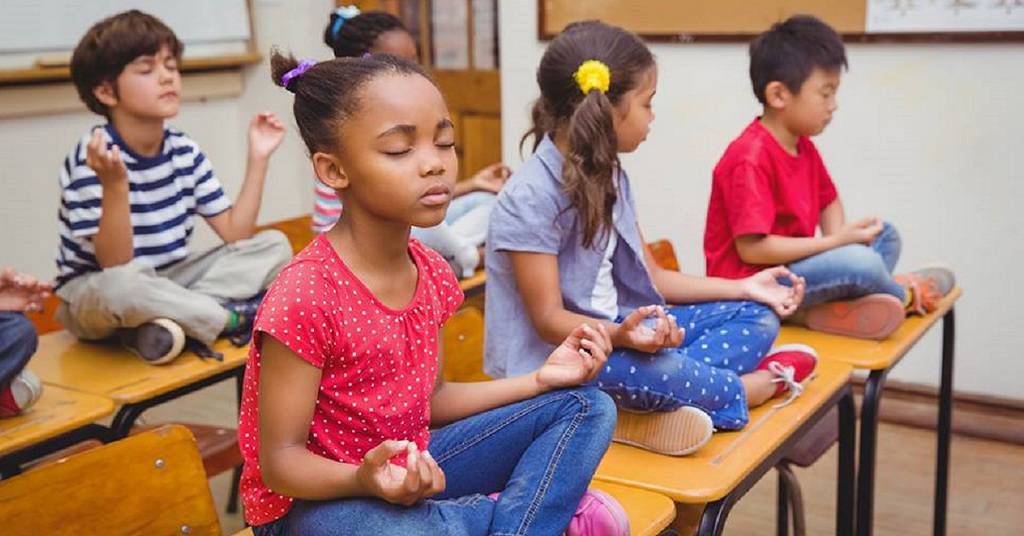
Students Meditating on Desks

At YogaKids, we speak to a lot of folks who teach children’s yoga. We also speak to lots of folks who WANT to teach children’s yoga. Some folks have self-doubt about their abilities to get up in front of a class. (To those beautiful people, we say that our program is guaranteed to bring out your best inner YogaKids Teacher.) Other folks — the ones who want to teach in schools — sometimes have trepidation about stepping on toes. We recently received a great inquiry about this…

“If I’m going to be teaching in schools, I want to be appropriate and in-line with standards [regarding religious teachings]. What is your stance on this?”

Such a thought-provoking question! From our perspective, yoga and religion are simply two different things. Nevertheless, we’ve been active in our community in addressing this topic. Mary Rountree, one of our YogaKids Teachers and Master Mentors, wrote a great article for our Press Room called “Is Yoga Religion?” As an educator in Alabama, she gets asked about this A LOT and has a number of great prepared answers.

“The Yoga Sutras, the most commonly cited text that forms the foundation for all forms of yoga, make no specific theological claims. The non-sectarian nature of this text has allowed it to remain solid for over 1500 years and allows freedom from religion, therefore making yoga a positive for anyone. The adaptability of modern yoga makes it diverse and flexible enough to be practiced with religion or with no religion. There are as many reasons why people do yoga as there are types of people that do yoga. They range from the secular, practical, body-oriented people to the most spiritual people and anything and everything in between. Yoga serves all these types because its teachings are universal.”

As you can see, it IS a great answer … if everyone is willing to listen and debate! But if that’s not the case, we also want to give a practical answer when asked about yoga and religion. Which is what we did with our new friend:

“Our program does include yoga philosophy but that is different than religion. Our recommendation? When you feel like the word ‘yoga’ is liable to spook someone – replace with ‘Mindfulness and Movement!'”

If you’ve been following trends in education, you know that Mindfulness is a big buzz word right now. It’s sweeping the nation and it’s kinda genius, really. Mindfulness can mean many things and, when combined with Movement — really does encompass so much of what yoga is… without the word “yoga.”

Now, does this undermine the word “yoga” and its depth of meaning? It’s a fair question. But our mission is so much bigger than words. Kids need our help, your help, the help of their communities. Words can sometimes get in the way.

What do you think?